Scenes
A scene = one idea on screen. You fill in its words and pictures.
 Wall of screensYour captures form a tilted wall drifting behind a line. It arrives thrown, brakes, then glides without stopping; in time with the music, one screen after another comes forward and lights up, and the camera moves a notch closer.
 Everything in orbitYour logo as a 3-D tile in the centre, with icons in a round about it, the near ones larger: the round arrives spinning, brakes, and the logo sends a spark to one icon after another, in time with the music: it jumps and takes your colour. Then the round spins up and the camera rushes at it.
 3-D carouselYour pictures go round a 3-D carousel, one notch per beat, behind a selection frame that locks on the middle one. Once locked, the wheel still pulls on the beat and the framed picture comes forward, until the scene ends.
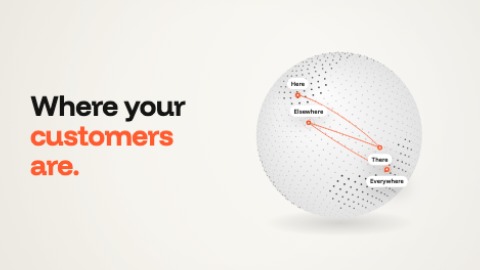 Around the globeA globe of dots turns beside your line: pins land on it one per beat, each with one of your words, and arcs join them.
 Round of iconsYour icons in a round, seen from the side: the near ones are twice the size of the far ones, and the middle stays empty. The round arrives spinning, brakes, and a ball of ink strikes one icon after another, in time with the music: the icon jumps and takes your colour. Then the round spins up and the camera rushes at it. Held longer, the camera runs along the round from very close, then the round seen from above bursts and ink covers the icons one by one.
 Ring of picturesYour pictures standing on a ring, like the cards of a rotary file. First a sunburst of thin lines in your colours, then the camera swings to the side: it is a carousel, turning. A hand parts it like pages being turned, one picture is uncovered and takes your colour, and the camera dives through the ring. Seen from above, your sentence is written in the middle.
 A line of tilesYour pictures on thick tiles standing one behind the other, in a line that starts close by and runs away into the picture. The line comes up from a corner, a hand lands on the first tile and sets it going like a conveyor, in time with the music; then it glides up the line and waits: every tile that passes under its finger lifts and lights up in your colour. The hand leaves, the line runs on.
 Constellation of screensYour first screenshot fills the picture, then the camera lets go of it and pulls back, faster and faster: five more screens burst in from every side, each at its own depth, and the whole set slides past the lens, the near ones much faster than the far ones. A short phrase lands in the middle (up to three, one after the other). Held longer, the camera pulls back again and more screens arrive.
 Screens and ribbonsYour screenshots standing side by side, like panels seen three-quarters on, on a gradient of your colours. A ribbon of your colour runs behind them, a second one slips in front of one and behind the next, panes of glass stand between them. Everything comes out of a blur, then the camera travels along the row, from one screen to the next in time with the music: the near ones sweep past, the far ones barely move.
 One of manyYour capture fills the screen, swells for an instant, then drops to a third of its size at once: it is one tile of a wall. Its neighbours pop in round it as flat tints in your colours and become your other captures. The wall never stops receding, a wave of colour crosses it, and it drops again: nine screens, fifty, two hundred.
 A wall wakes upA dense wall of your pictures fills the screen edge to edge. It is born along a diagonal, each picture first as flat tints in your colours, then a second wave makes them true. A veil comes down, your line is written on it, and a hand crosses the wall: the pictures it passes light up again, and a few stay lit.
 Wall and wordHundreds of small pictures packed into a wall, seen through the bulging glass of an old screen, with its lines and its dark edges. In the middle, a disc in your colour and one very large word, replaced at once by the next, in time with the music; the last one stays longest. The picture comes closer faster and faster and rushes at you just before the cut.
 A wall fills upYour line is written word by word in a selection box that widens with it, in the middle. Meanwhile your pictures fly in from every side and tile the screen around it like masonry. A wave tints them in your colours, then a second one, in time with the music, gives them back their true colours. In a longer scene the wall steps back and dashed outlines group a few pictures, each with its caption.
 ProCorridor of picturesThe camera rushes down a corridor whose walls, floor and ceiling are lined with your pictures; your line waits at the far end, the camera creeps towards it, then rushes through it; the corridor tilts a little on the way; at the far end, one picture faces you and comes up to fill the screen.
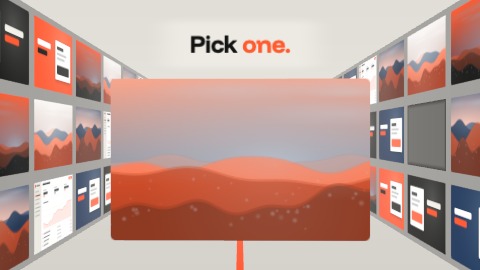 ProOff the wallA corridor whose two walls are covered with your pictures; the camera moves slowly down it. One picture peels off its wall, flies without slowing and lands in front of you with a bounce. Its place stays empty in the wall. You choose the wall and the row it comes from.
 ProStoryboard drawing itselfA storyboard pinned on a board, its panels made of your pictures. They are drawn in pencil column after column, in time with the music: the outlines, then the hatching. Then a wave of paint with a wet edge crosses the board and gives them back their colours. You choose the number of panels.
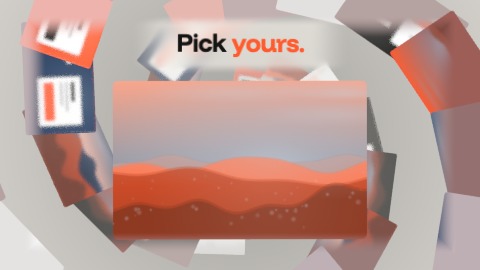 ProGalaxy of picturesYour pictures are the arms of a galaxy turning round one point, from the corners of the screen far into the distance, seen through a lens: what is not in focus stays soft. The galaxy starts fast and slows down; one picture escapes it, rushes at you and lands under your line with a bounce, and everything else goes soft behind it.
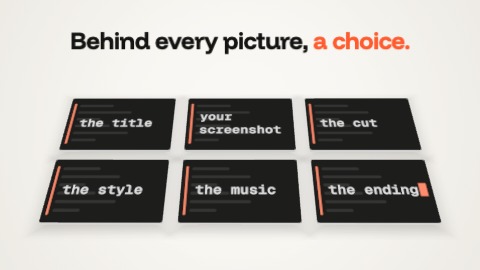 ProBehind the scenesYour pictures lie on a table, seen from above. A wave tips them one after the other: each lifts, lands on its back with a bounce, and a line of your list is typed on it, what the picture hides. Then a second wave puts them back face up, or they stay on your words if you choose.
 ProLiving mosaicA wall of your pictures that fills the screen and never stops: rows of tall tiles and wide tiles, each sliding its own way, at its own speed and depth, while the whole wall slowly draws back. In the middle your figure counts on reels or your word lands, with your small line. At the end every tile pours into the title, the farthest last. Three viewing angles.
 ProBursting ringYour pictures burst out round your line. With your labels on small pills, first in two tones of your colours, then in their own, the ring settles, widens and turns slowly, each picture on its own orbit; it gives a kick when the line that follows takes the first one's place, then falls into its middle and becomes a sphere of light. Head on, or in orbit seen from above.
 ProWall in depthA wall of your pictures that looks flat until the camera moves: each one hangs at its own depth. The camera pulls back, then sweeps sideways twice; the near pictures slide faster than the far ones, and the far ones are slightly out of focus.
 ProWord framed in picturesYour pictures burst in round your word. The camera pulls back from your word and its switch, your pictures packed edge to edge like a frame, first passed through the gradient of your colours, then in their own; the switch turns on in your colour, each picture lives at its own depth, then the camera draws away, faster and faster, into the cut. Head on, or the frame tilted.
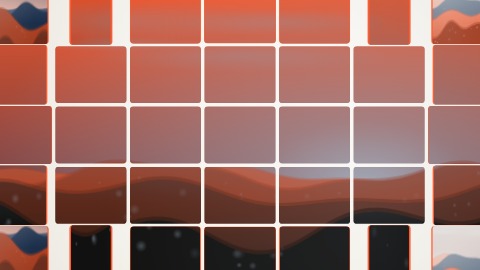 ProMosaic waveYour pictures turn over into one picture. A wall of your pictures packed across the screen; a wave turns every tile over like a card, a thin edge of your colour showing as it turns, and on its back each tile holds its piece of one big picture: the joints close, the big picture stands whole and your line lands on it. From the middle or from a corner.